

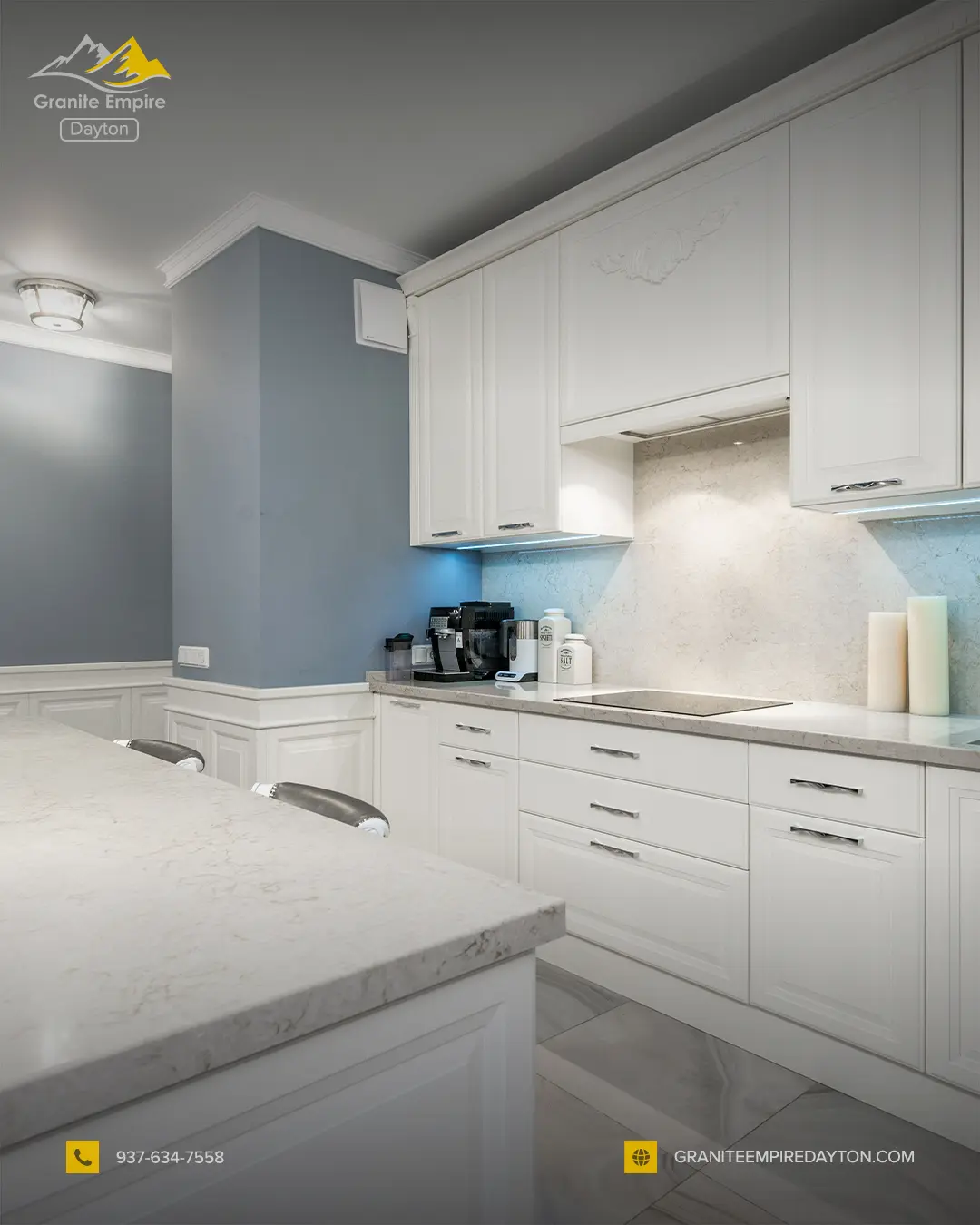
Short Answer: Professional countertop fabricators in Milford, OH handle seams by planning their location before cutting, matching the stone pattern across the joint, and using color-matched epoxy to create a nearly invisible bond. Edges are shaped using computer-controlled routers and then hand-polished through multiple grits to achieve a smooth, consistent finish. At Granite Empire of Dayton, we handle every seam and edge in-house with digital templating, precision CNC cutting, and hand-finishing. Our granite package is $1,999 for 50 square feet installed, and our quartz package is $3,000 for 50 square feet. We serve Milford and the entire greater Cincinnati and Dayton area.
Why Seams and Edges Matter in Countertop Fabrication
Seams and edges are the details that separate professional countertops from amateur work. A poorly placed seam draws the eye immediately. A rough edge feels wrong under your hand. A mismatched pattern across a joint looks like a mistake.
For homeowners working with countertop fabricators in Milford, OH, understanding how seams and edges are handled helps you evaluate quality. The best fabricators plan seams before cutting, not after. They polish edges by hand, not just with a machine. And they show you the results before installation.
This guide explains exactly how professional fabricators handle seams and edges, what to look for, and what questions to ask.

How Fabricators Plan Seam Locations
Seam planning begins before any cutting. Professional countertop fabricators consider several factors when deciding where seams will fall.
Slab Size and Kitchen Layout
Granite slabs typically measure about 9 to 10 feet long and 5 to 6 feet wide. Most kitchens require more than one slab, which means at least one seam. The fabricator maps the digital template against the slab dimensions to determine the minimum number of seams and the best placement.
Stress Points
Seams should never fall directly over a dishwasher, an overhang, or a cabinet gap. These areas flex and create stress on the joint. A seam over a dishwasher can separate over time due to heat and vibration. Professional fabricators place seams over solid cabinet supports.
High-Visibility Areas
Seams should be placed away from the most visible parts of the kitchen. The center of an island, the area directly in front of the main entry, and the space beside the sink are all high-visibility zones. Better locations include corners, areas behind appliances, and sections near the backsplash.
Pattern Flow
For veined materials like granite and marble, the seam location must allow the pattern to continue naturally across the joint. This is called vein matching or pattern matching. The fabricator positions the seam where the veining is most likely to align.
We mark seam locations on the actual slab and review them with you before cutting. You see exactly where the seam will be and how the pattern will flow. You approve the layout before fabrication begins.
How Fabricators Create Nearly Invisible Seams
Creating an invisible seam is part art, part science. Professional countertop fabricators in Milford, OH follow a precise process.
Step 1: Dry-Fit
Before any epoxy is applied, the fabricator dry-fits the pieces together. This verifies alignment and reveals any issues. If the seam does not close tightly, adjustments are made before the permanent bond.
Step 2: Color-Matched Epoxy
The fabricator mixes two-part epoxy with pigments to match the color of the stone. For veined materials, the epoxy may include multiple colors blended to mimic the natural pattern. A seam on White Sparkle will use different pigments than a seam on Ubatuba Green.
Step 3: Application and Clamping
The epoxy is applied to both edges. The pieces are pushed together and clamped. Excess epoxy is removed before it cures. The goal is a bond that is flush with the surface, not raised or recessed.
Step 4: Finishing
After the epoxy cures, the fabricator sands and polishes the seam. The finish must match the surrounding stone exactly. A properly finished seam cannot be felt with a fingernail.
Our fabricators match patterns across seams for a continuous flow. We use color-matched epoxy and hand-finish every seam. The result is a joint that is nearly invisible to the eye and smooth to the touch.
How Fabricators Shape and Polish Edges
Edge profiles are shaped after cutting but before installation. Professional countertop fabricators use a combination of machinery and hand work.
Computer-Controlled Routing
The edge shape is cut using a CNC router or a hand-held router with a profile bit. Common profiles include eased, beveled, bullnose, ogee, and straight. The router creates the rough shape, but it is not the final finish.
Hand Polishing
After shaping, the edge is polished through a series of diamond-impregnated pads. Each pad is finer than the last. A typical sequence goes from 50 grit to 100, 200, 400, 800, 1500, and finally 3000 grit. The result is a smooth, glossy finish that matches the surface of the countertop.
Edge Consistency
Every edge on every piece must match. A fabricator cannot polish one edge more than another. Consistency is checked by running a hand along the edge and comparing the finish under different lighting angles.
At our company, every edge is hand-polished to a consistent finish. We do not rely on machines alone. Our fabricators inspect every edge before the countertop leaves the shop.
Common Seam and Edge Mistakes to Avoid
Not all countertop fabricators in Milford, OH maintain the same standards. Watch for these common mistakes.
Seams placed in high-visibility areas like the center of an island or directly beside the sink. Mismatched pattern across a seam, where the veining does not flow naturally. Raised or recessed seams that can be felt with a fingernail. Rough edges that catch on cloth or feel uneven. Uneven polish where one section of the edge is glossier than another. Chipped edges caused by dull tools or rushed fabrication.
We avoid all of these mistakes through careful planning and patient craftsmanship. We show you seam locations before cutting. We hand-polish every edge. And we inspect every piece before installation.
What to Ask Fabricators About Seams and Edges
Before hiring countertop fabricators, ask these questions.
Where will the seams be located? Can I approve the seam placement before cutting? How do you match the pattern across seams? What color-matched epoxy do you use? How many grits do you use to polish edges? Can I see samples of your seam work and edge profiles? What happens if a seam fails after installation?
We answer all of these questions clearly. We show you photos of completed seams. We provide edge profile samples in our showroom. And we back our work with a full craftsmanship warranty.

FAQ: Seams and Edges from Countertop Fabricators in Milford, OH
Q: How do countertop fabricators make seams invisible?
A: They plan seam locations before cutting, match the stone pattern across the joint, use color-matched two-part epoxy, and hand-finish the seam after curing. We show you seam locations before cutting.
Q: Where should seams be placed on granite countertops?
A: Seams should be placed away from stress points like dishwashers and overhangs, away from high-visibility areas like island centers, and where the pattern can flow naturally. Professional fabricators plan seam locations based on your specific layout.
Q: What is the best edge profile for granite countertops?
A: The best edge profile depends on your style and needs. Eased and beveled edges are classic and easy to clean. Bullnose edges are safest for families. Ogee edges are traditional and decorative. We offer all these profiles.
Q: How do fabricators polish edges to a smooth finish?
A: Edges are shaped with CNC routers and then hand-polished through multiple diamond grits, from 50 to 3000. The final result is a smooth, glossy finish that matches the countertop surface.
Q: Can I feel a seam on a professionally fabricated countertop?
A: A properly finished seam should not be felt with a fingernail. If you can feel a raised or recessed edge, the seam was not finished correctly. We hand-finish every seam to a smooth, flush surface.
Q: How much do granite countertops cost?
A: At our company, granite starts at $45 per square foot with a package of $1,999 for 50 square feet installed, including sink, cutouts, installation, and old countertop removal.
Q: Do fabricators offer edge profile samples?
A: Yes. Granite Empire of Dayton has edge profile samples in our showroom. You can see and feel the different options before making your decision.
Q: What is the average lead time for countertops?
A: At our company, most projects complete within 7 to 14 days from consultation to installation.
Contact Information for Granite Empire of Dayton
Ready to work with experienced countertop fabricators in Milford, OH who handle seams and edges with precision? our company offers in-house fabrication, digital templating, and hand-finished seams and edges. Our granite package is $1,999 for 50 square feet including sink, cutouts, installation, and old countertop removal.
Visit our showroom to see full slabs of White Sparkle, Dallas White, Azul Platino, Luna Pearl, Gray Star, Ubatuba Green, and Giallo Ornamental. Our team will show you seam samples and edge profiles so you know exactly what to expect.
We serve Milford and the entire greater Cincinnati and Dayton area.
Granite Empire of Dayton
Call or text: (937) 634-7558
Visit our website: graniteempiredayton.com